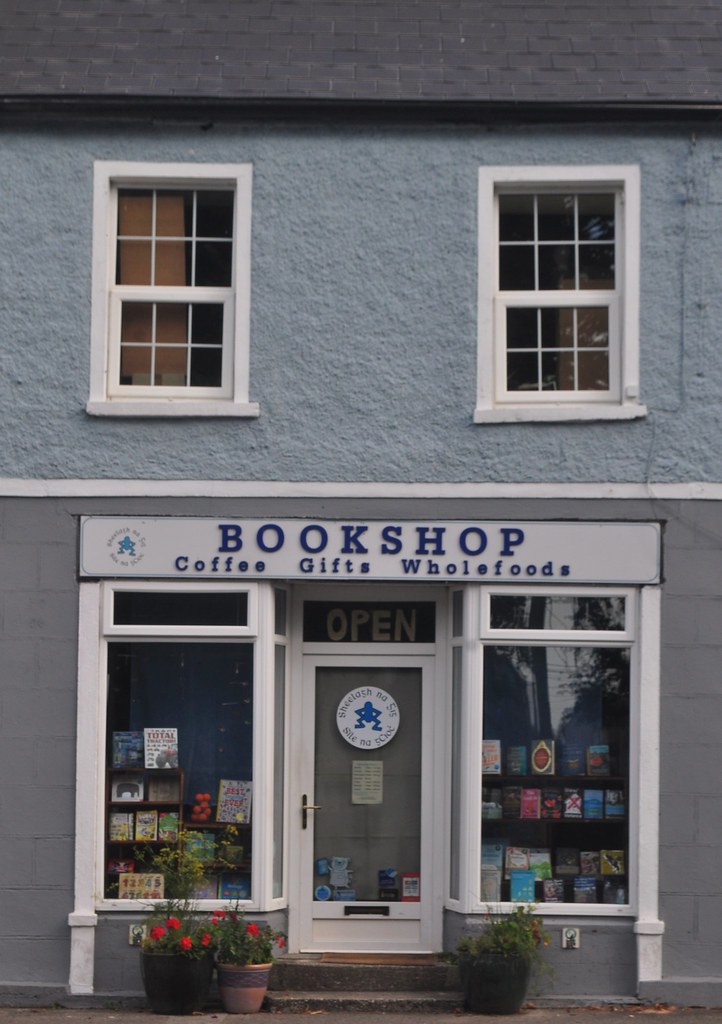
The Periwinkle Bookshop opened on a Tuesday in March 2024, in a former butcher's premises on Main Street in Ennistymon, a market town of about a thousand permanent residents in north County Clare.
It is owned and run by Aoife Lenihan, who is thirty-eight, who returned to Clare in 2023 after eleven years working in publishing in Dublin and London, and who designed the shop's business model with the explicit assumption that conventional retail bookselling would not work in a town of this size.
Her solution is a subscription model. Members pay one hundred and eighty euros a year, in twelve monthly instalments of fifteen euros each, and receive one curated paperback or hardback per month, chosen by Lenihan, alongside membership of a small lending library housed at the rear of the shop.
The shop carries about twelve hundred lending titles. It also stocks, at the front, a small rotating selection of perhaps three hundred new titles for walk-up sale to non-members. The non-member retail trade exists, but the shop is not financially dependent on it.
As of May 2026, the shop has four hundred and seventeen subscribers. About sixty percent live within ten kilometres of Ennistymon. The remaining forty percent are spread across Ireland, the UK, and as far as a single member in Vermont, who receives her monthly book by surface post and accepts a four- to six-week delivery window.
The subscriptions generate approximately seventy-five thousand euros a year in stable, predictable revenue. The walk-up retail and the small café at the back of the shop bring in perhaps another thirty thousand. Lenihan pays herself a salary of twenty-eight thousand, pays a part-time bookseller named Conor Maher twelve thousand, and covers the lease and operating costs out of the remainder.
The model is fragile. Lenihan is the first to say so.
A drop of fifty subscribers — which she has not yet experienced but which she models in her annual planning — would, she says, require her to take a second job or close the lending library. A drop of a hundred would close the shop.
What she has been working on, slowly, is the conversion rate from one-time book buyer to subscriber. Approximately one in nine walk-up customers becomes a subscriber within their first year. She would like this to be one in seven.
She is, she says, not in a hurry.
The curation is the work that distinguishes Periwinkle from a conventional rural bookshop. Lenihan reads, by her own conservative estimate, between seventy and a hundred new titles a year in galley form. She maintains relationships with publicists at twelve UK and Irish independent presses, who send her advance copies.
She also maintains a small backlist programme. Each year, three of the twelve monthly subscriber titles are older books — usually published more than ten years previously — that Lenihan selects for what she calls persistence. They are not new releases. They are titles she believes a reader will keep.
Recent backlist selections have included Marilynne Robinson's Housekeeping, John McGahern's That They May Face the Rising Sun, and a 1984 collection of short stories by the Australian writer Helen Garner.
The new releases lean toward translated fiction, small-press Irish writing, nature writing, and what Lenihan calls quiet non-fiction — sustained works of essay or history that do not announce themselves loudly.
On a wet Friday afternoon in late May, the shop holds nine customers. Four are subscribers collecting their May book, which is a paperback of Annie Proulx's Fen, Bog and Swamp. Three are walk-up customers, two of whom are German tourists who have wandered in off the street and one of whom is a local woman who comes in every Friday and has, in two years, never bought anything.
The remaining two are children — a boy of perhaps eight and a girl of perhaps ten — who are reading on the floor in the children's corner, which is curtained off from the rest of the shop and holds about a hundred picture books and middle-grade titles selected by a teacher from the local national school who consults with Lenihan once a quarter.
Conor Maher works the till. He has been at the shop for fourteen months. He was a secondary-school English teacher before he came to Periwinkle and he handles the children's-corner traffic with a fluency that Lenihan, by her own admission, does not match.
The café occupies a small room at the back of the shop. It serves coffee, tea, soup, and a single sandwich that changes weekly. It does not have a menu beyond a small blackboard. The sandwich, on the Friday, is a cheddar and pickle on brown bread.
The café is run on a margin Lenihan describes as just-positive. Its purpose is not profit. It is to give customers a reason to stay in the shop for forty minutes rather than four.
The model has worked, by Lenihan's measure, about as well as she had hoped and slightly better than her business plan projected. She is not, she says, building a chain. There will not be a second Periwinkle.
What she is interested in, she says, is whether the model can be documented in enough detail that another bookseller in another small town in Ireland or the UK might be able to adapt it. She has, over the last year, given informal advice to a woman in Tobermory who is considering a similar venture, and to a man in Hay-on-Wye who is, more conventionally, opening a fourth shop in a town that already has more bookshops than petrol pumps.
Lenihan closes the shop at 6 p.m. on Fridays. The till on the Friday in question shows eleven walk-up transactions totalling one hundred and forty-two euros, plus the seventeen subscriber pickups, which have already been paid for.
She locks the door. She walks home through the rain along the river that gives the town its name. The shop, behind her, holds twelve hundred lending titles and a small café and a model that she will, again, balance in the morning.