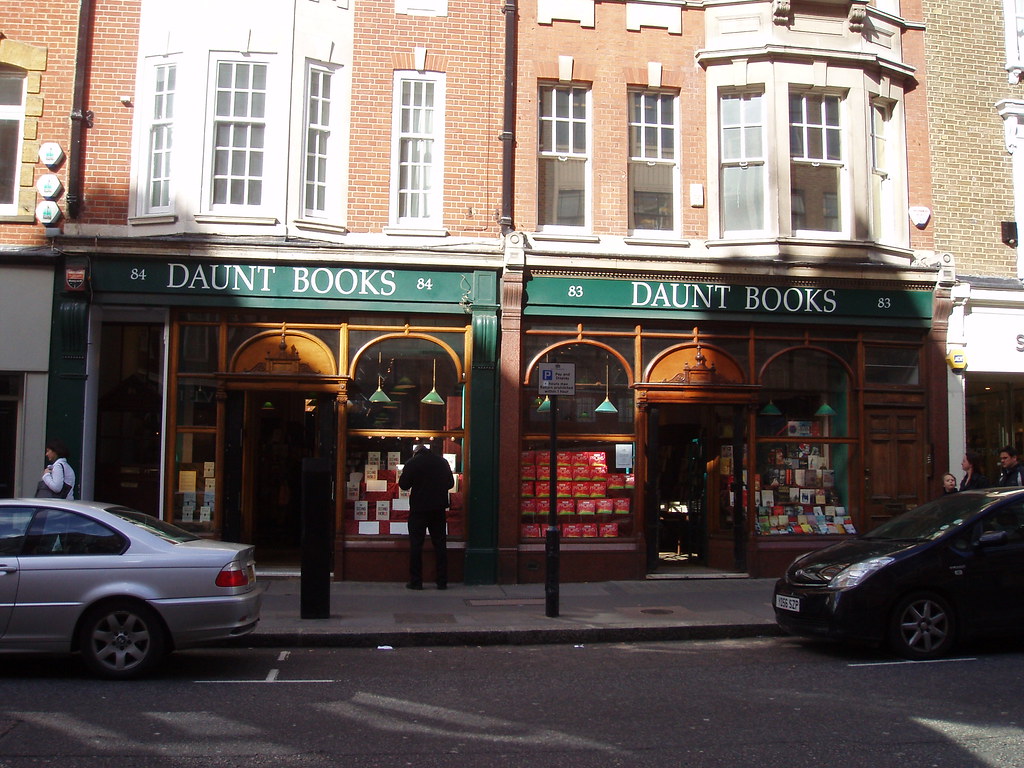
The shop at 83 Marylebone High Street opened as a bookseller in 1912, under the proprietorship of Francis Edwards, who specialised in antiquarian works on travel and natural history.
It opened as Daunt Books in 1990, when James Daunt took it over and kept the principal architectural feature intact: a long oak gallery that runs the full depth of the shop, lit from above by a stained-glass skylight that throws a quarter-light onto the parquet at all hours when the sun is anywhere in the southern sky.
There is no other bookshop in London quite like it, and there are perhaps only four others in the world.
The galleried hall is fifteen metres long. The oak shelves run two storeys high on both sides. A narrow walkway, reached by a staircase at the back, lets a reader stand at the gallery level and look down over the heads of the customers below.
Most visitors, on entering, stop walking. They look up. They look forward. They take perhaps four steps, then stop again.
Daunt's organising conceit is that the shop is arranged by country rather than by genre. A novel by Mahfouz sits beside a Lonely Planet on Egypt, beside a history of the Wafd party, beside a 1923 Baedeker, beside a translation of Cavafy because the shop's classifiers have decided Cavafy is, on balance, more Alexandrian than Greek.
This is, depending on one's view, either an inspired editorial decision or a logistical inconvenience for anyone shopping for a specific title. It is both, of course, and the shop's success suggests that the first reading outweighs the second.
On the afternoon of a Saturday in late April, the shop is full but not crowded. The acoustics of the hall — high ceiling, soft furnishings, oak — absorb the sound of forty people browsing into something that registers as a low and continuous shushing.
A man in a navy overcoat stands in front of the Russia section for nineteen minutes. He picks up, in order: a paperback of A Hero of Our Time, a hardback of Figes's Natasha's Dance, a thin volume of Akhmatova in Hemschemeyer's translation, and a Bradt guide to Karelia.
He buys none of them. He puts each back in the wrong place, which is not unusual.
The shop's staff re-shelve about 600 misplaced titles per week, according to a figure that one of the booksellers mentioned in passing to a journalist in 2019. The figure has not been updated. It is probably higher now.
The gallery is reached by a staircase at the rear of the hall, and a small sign asks customers to be quiet on the upper level. Most are. Sound carries down to the main hall with surprising clarity, and a whispered conversation about Patagonian fly-fishing on the upper gallery can, on a still afternoon, be heard distinctly at the till.
The fiction tables at the front of the shop carry the standard inventory of a thoughtful contemporary bookseller: new translations from Fitzcarraldo, Pushkin and NYRB, the latest Sebald reissue, a paperback edition of Annie Ernaux's The Years with a Daunt sticker on the front recommending it for the seventh consecutive year.
The non-travel sections — children's, gardening, cookery, art — are housed in side rooms off the main gallery. They are quieter, more like the rooms of a private library, and they have their own dedicated booksellers who know the stock with a depth that the main floor cannot quite manage.
The children's room, in particular, has a quality of seriousness that is rare in retail bookselling. The picture books are face-out. The middle-grade fiction is shelved at child-height. The young adult section is not separated from adult fiction by anything except a low wooden partition.
The shop sells, in addition to books, a small range of tote bags, notebooks, and a famously well-designed paper carrier bag in dark green with white lettering. The carrier bag has, over thirty years, become a London signifier of a particular kind, and it is occasionally seen, empty and folded, being sold on the resale market for sums that would buy three of the books that originally came in it.
Daunt Books is, financially, an unusual case among independent bookshops. It is part of a small chain of nine shops, owned by James Daunt, who is also the chief executive of Waterstones and, since 2019, of Barnes & Noble. The Marylebone shop subsidises and is subsidised by the chain in ways that are not made public.
What the customer experiences, however, is not a chain. It is a single shop, in a particular building, with a particular voice. The handwritten recommendation cards under selected books are written by the shop's own booksellers, and they bear initials.
SM recommends Crossing the River by Caryl Phillips with a sentence that reads: This is the West African slave-trade novel I keep returning to, and I am not sure why.
JR recommends a new translation of Ngugi wa Thiong'o's The Perfect Nine with: An epic in 235 pages, which is exactly the right length for an epic in 2026.
The shop closes at 7 p.m. on Saturdays. By 6:45 the light through the skylight has gone honey-coloured and then grey, and the electric lights along the gallery come on one by one as a bookseller named Anya works her way down the row with a remote control she does not, strictly, need but enjoys using.
By 6:58 the shop has thinned to a half-dozen customers and the man in the navy overcoat, who has returned to the Russia section.
He buys, finally, the Akhmatova. He pays in cash. He is given a green bag, which he does not need, and he carries the small paperback in it back out onto the high street, where the lights of a pizzeria across the road are already on for the evening trade. The bell above the door of Daunt rings once as he leaves, and the shop, briefly, is quiet.