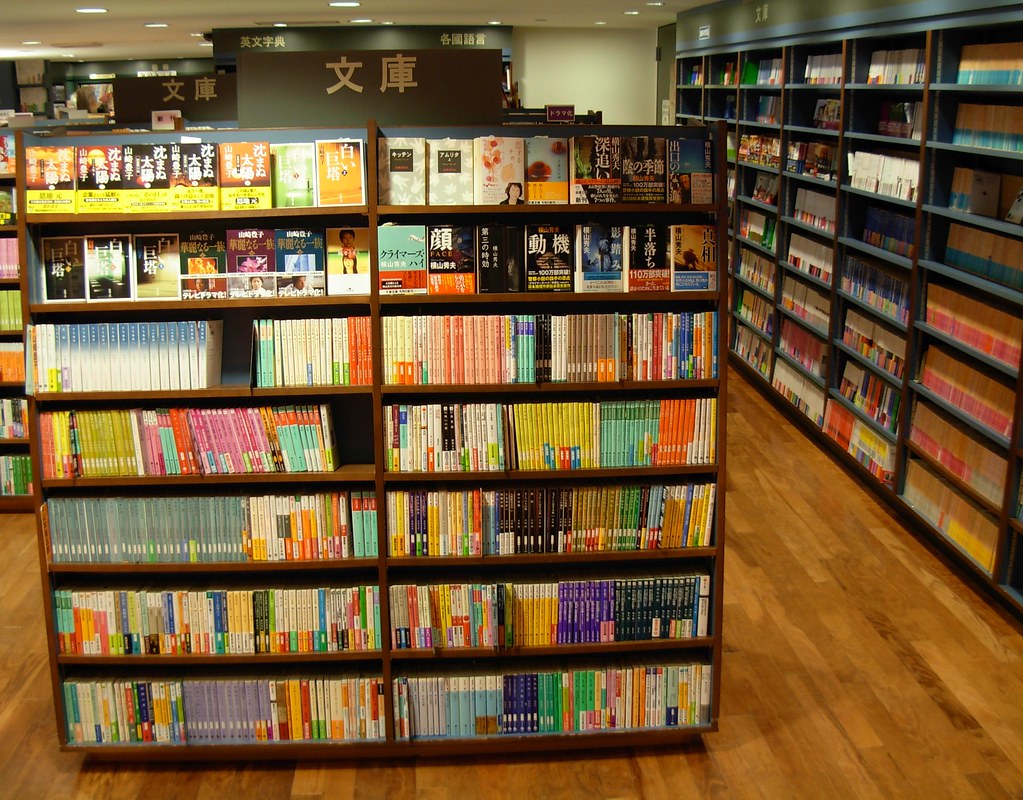
Morisaki Books occupies a ground-floor storefront on a side street in the Jimbocho neighbourhood of central Tokyo, four metres deep and two and a half metres wide, with a single door, no front window, and a sign in vertical kanji that reads, in translation, Books, slowly.
Inside the shop are nine shelves. Each shelf holds approximately twelve titles. The total stock on the floor at any time is one hundred and eight books.
The shop is owned and operated by Hideo Morisaki, who is sixty-four years old, who worked for thirty-one years as an editor at Shinchosha before he opened this shop in 2019, and who selects every title personally.
Morisaki rotates the entire stock every three months. On the first day of January, April, July, and October, he removes all 108 titles and replaces them with a new selection. The cleared titles are sold to other Jimbocho dealers at wholesale, donated to a local prison literacy programme, or kept in a small warehouse he rents three streets away.
The shop is open from 11 a.m. to 7 p.m., Tuesday through Sunday. Morisaki opens it alone. He takes lunch at a noodle shop two doors down at 1:30. He closes the shop for an hour during this break.
There is a single chair in the shop, by the door, and no other seating. Customers stand. Most customers, when they enter, take perhaps thirty seconds to absorb the smallness of the inventory before they begin to read titles.
The nine shelves are organised by Morisaki according to a system he calls nakaba, which translates approximately as middle path. The shelves are not labelled. There is no section signage. The arrangement is, as far as one can determine, intuitive.
On a Wednesday in early May, the stock includes a new translation of Clarice Lispector's Água Viva into Japanese, a 1976 paperback of The Box Man by Kōbō Abe, a hardback of W. G. Sebald's The Rings of Saturn in the Suzuki translation, a small chapbook of essays on architecture by a Kyoto critic Morisaki published himself in 2024, and a 1993 first edition of Yoshimoto Banana's Amrita that he picked up at a Jimbocho dealer's auction the previous month.
There are also four cookery books, two volumes of poetry, a 1962 photographic monograph of Ise Shrine, and one book in French — a Gallimard paperback of Marguerite Duras's Moderato Cantabile that has been on the shelf for six weeks and which Morisaki, when asked, says he keeps because someone, someday, will want it.
The shop's clientele is not large. Morisaki estimates that he sees between fifteen and forty customers a day, depending on the season and the weather. Of those, perhaps a third buy something.
The economics, he will admit if pressed, do not work on the bookshop alone. The shop is supported by a small consultancy he runs alongside it, advising other publishers on editorial selection, and by occasional translation work.
What the shop offers him, he says, is not income. It is a daily practice of editorial judgment in three dimensions — the physical fact of a book on a shelf, considered against the eight others on that shelf and the ninety-nine elsewhere in the room.
Morisaki has written and spoken about this practice in essays and on a single appearance on a literary radio programme in 2023. He describes it as kihon no henshū — the editing of the foundational. He means: deciding what should exist in the world at all.
The price points in the shop are higher than at the larger Jimbocho stores. A new paperback that retails elsewhere in Tokyo for 1,200 yen sells at Morisaki Books for 1,400. A used hardback that might cost 3,000 yen at a competitor sits at 3,800 here.
Morisaki does not apologise for this and his customers, by and large, do not ask him to. They are paying, in effect, for the selection — for the labour Morisaki has performed on their behalf in advance of their arrival.
On the Wednesday afternoon, a young woman in her late twenties enters the shop, walks the length of it in eight seconds, and stops in front of the third shelf from the right.
She picks up the Sebald. She turns it over. She opens it to the photograph of the herring on page 56. She reads, standing, for nine minutes. She closes the book, brings it to the counter, and pays in cash.
Morisaki wraps the book in unbleached paper, ties it with a single length of jute twine, and bows once as he hands it across the counter. The customer bows back, takes the book, and leaves without speaking.
Morisaki returns to the chair by the door. He picks up a small black notebook in which he keeps a record of every sale, by title and date and rough customer description. He writes, in his small upright hand: Sebald, Saturn, young woman, glasses, blue raincoat.
He has, since the shop opened in 2019, filled fourteen of these notebooks. They sit in a wooden box under the till. They are not for any reader other than himself.
The shop closes at 7:02. Morisaki sweeps the floor with a small broom, switches off the single overhead light, and locks the door with a key on a leather fob.
He walks home. The walk is twenty-three minutes. The 108 books remain on their shelves overnight, in the dark, in a small room in central Tokyo, waiting for a Thursday.