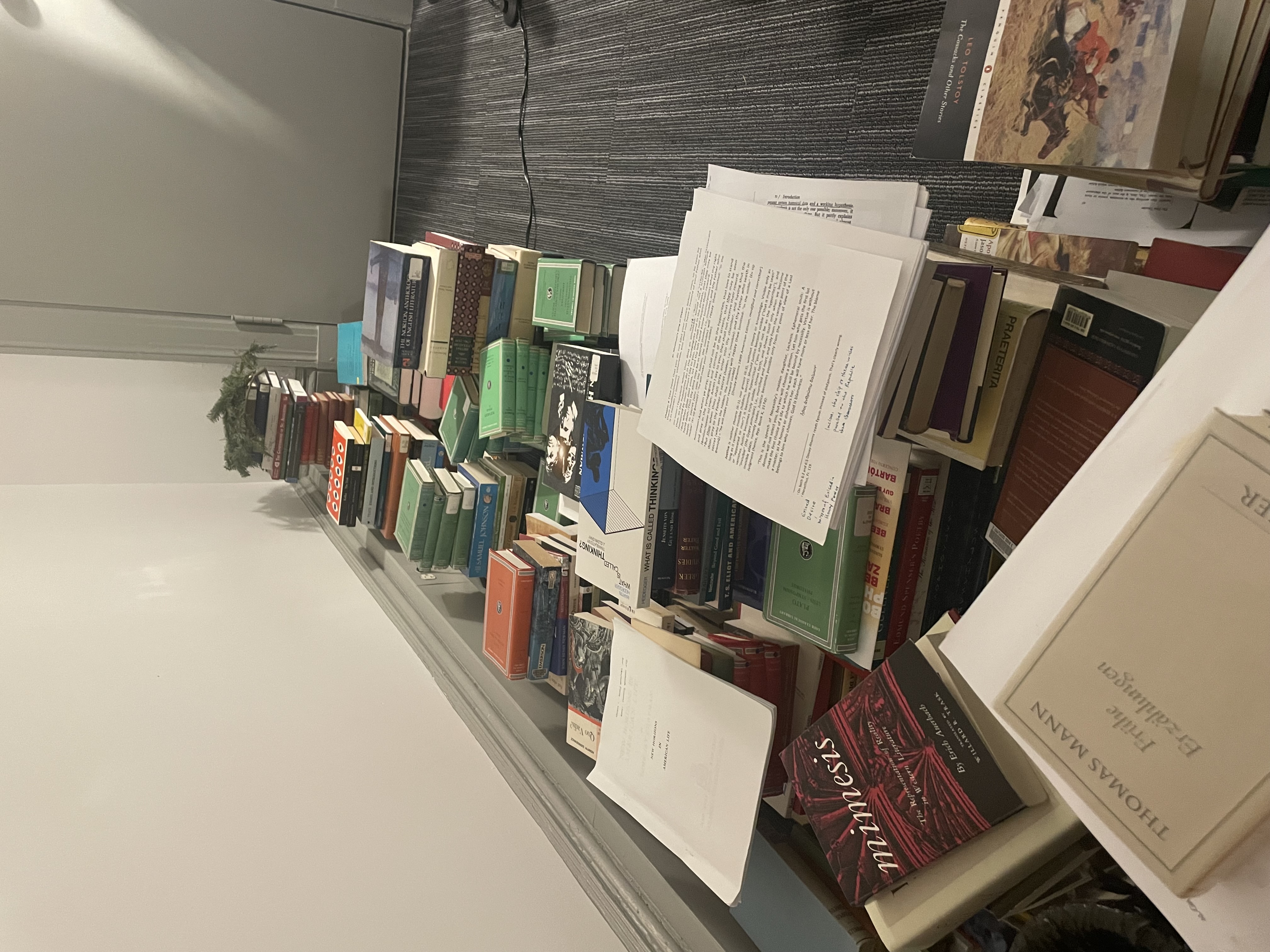
Saul Pickering has, in the flat in Stoke Newington, somewhere between four hundred and five hundred and fifty books he has bought and not read. He does not know the exact number. He is afraid, slightly, to count.
There is a Japanese word for this — tsundoku, often translated as the practice of acquiring books without reading them — and the word has been having a small moment in English-language essays over the past five years.
Most of those essays are some variation on a defence. They say that the unread stack is a sign of curiosity, a kind of intellectual hospitality toward future selves. They quote Umberto Eco, who reportedly maintained that the books one has read are the boring ones, and that the library is most interesting in its unread fraction.
Pickering, in the essay he wrote for the magazine in early June, says he wants to take the defence seriously and then, mostly, to set it aside.
He wants to set it aside because he thinks the defence is partly self-flattering, and because he thinks the actual experience of having a large unread stack is more ambivalent than the defence allows.
The actual experience, in his case, is that the unread stack produces a low-grade, persistent, slightly comic guilt.
He passes the shelves. He sees the spine of, say, Robert Musil's The Man Without Qualities, which he bought in 2011 in a Dublin bookshop, and which he intends, every year, to read. He has not read it. He may not read it. The book sits on the shelf and is, he says, slightly accusing.
This is not a tragic situation. It is a comic one, and Pickering treats it as such throughout the essay.
His argument, after thirteen years of comic guilt, is that the unread stack is best understood not as a reading list but as a reference collection.
A reading list is something one intends to work through. A reference collection is something one keeps in case one needs it. The two have different psychological weights.
The unread stack, treated as a reading list, is a list of debts. Each book is a debt the reader owes herself, and the stack is the running total. This is unpleasant, and it is the source of the guilt.
The unread stack, treated as a reference collection, is a small private library of resources. Each book is a possible answer to a question one has not yet asked. The Musil is there in case one needs Musil. The Berger is there in case one needs Berger. One does not owe anyone anything.
This is a small psychological reframing, and Pickering does not claim it is profound. He claims only that it has, for him, made the shelves easier to live with.
There are practical implications. If the unread stack is a reference collection, then it is reasonable to keep books one does not intend to read cover-to-cover. It is reasonable to keep the Pevear-Volokhonsky Brothers Karamazov on the shelf for the day one needs a Karamazov passage and not before.
It is also reasonable, under this view, to occasionally remove a book from the stack without reading it, if it has become clear that the book is not a resource one is going to use.
Pickering has, in the past two years, given away about ninety books that he had bought and not read. None of these were books he had been intending to read for more than five years. He found the act of giving them away easier than he expected.
What was difficult was the books he had been intending to read for more than ten years. The Musil. A Mavis Gallant collection bought in 2008. A György Konrád novel in translation that he has owned since 1999.
These books, he writes, are not really unread books anymore. They are companions. The intention to read them has, over the decade, become part of their function. To give them away would be to retire the intention, which is not quite the same as retiring the book.
He has decided, he says, to keep them. He has also decided to stop apologising for them.
There is a small further point, which he raises in the essay's last paragraph, about the relationship between the read shelf and the unread shelf.
The read shelf is, in some sense, the smaller library — the books one has actually used. The unread shelf is the larger library, and it is the one that records the reader's ambitions. Both are useful records, and a reading life with only one of them would be poorer than a reading life with both.
Pickering is not in favour of buying books one will never read. He thinks the deliberate accumulation of an unread library, as a kind of display, is a small vice and a slightly silly one.
He is in favour, however, of being honest about the fact that the reader's library will, if the reader keeps reading and keeps buying, always contain more unread books than read ones. This is not a failure. It is the shape of an active reading life.
The Musil, he writes, is still on the shelf. He will probably not read it this year. He will probably not give it away either. It is, by now, a book that has earned its place, and the place it has earned is to be the book he has not, all these years, read.