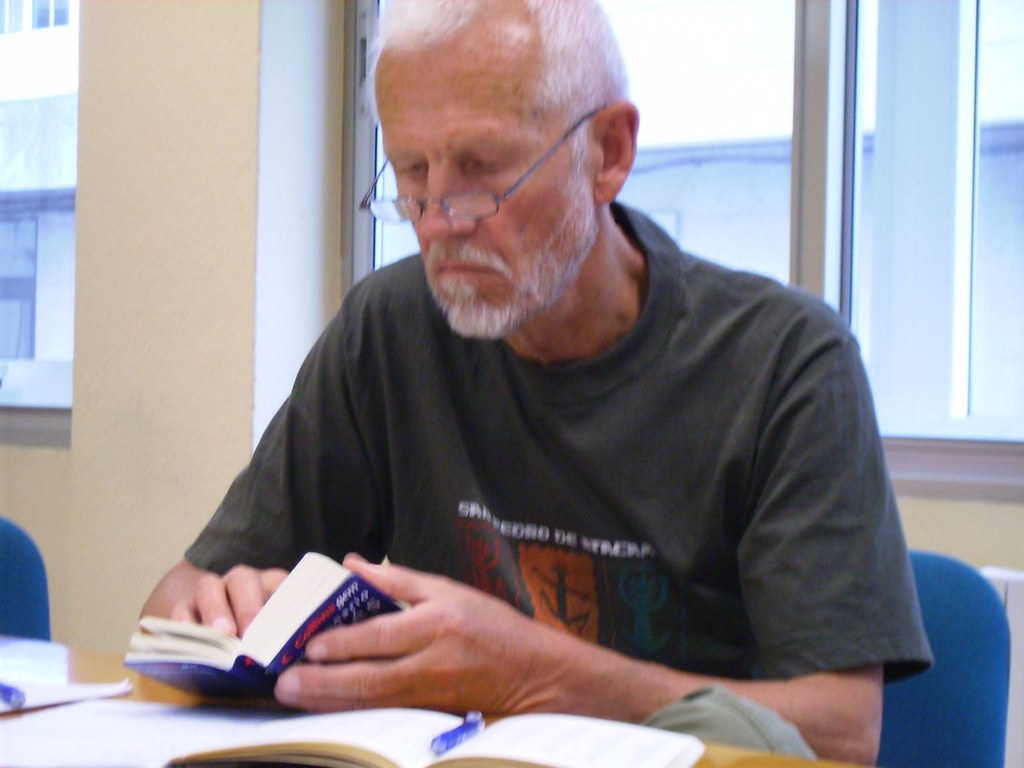
Anna Mareu's bench is a kitchen table in the Gràcia neighbourhood of Barcelona, three streets up from the Plaça del Diamant. On the morning of 4 February 2026, it held two dictionaries, a typed manuscript with red pencil marks, a small cafetera, and the Penguin paperback of La plaça del Diamant that she has carried since university.
She was working on a sentence she had translated four times.
The book is a collection of Mercè Rodoreda's late stories, the ones written in Geneva exile in the 1960s and 1970s, and her English version will appear from Wolfgang Books in Brooklyn in October. Wolfgang prints in runs of 1,500. Mareu will be paid, in total, about 6,400 euros for fourteen months of work.
She is forty-three and translates full-time, which is rare. She supplements with reader's reports for two London agencies and a Tuesday afternoon class at the Universitat Pompeu Fabra.
The sentence she was rewriting describes a woman watering geraniums on a balcony in the Eixample in 1971. The Catalan verb Rodoreda uses is amoixar, which the standard dictionaries gloss as to stroke or to caress. Mareu had tried stroked, then petted, then tended to, and that morning she wrote fussed over in the margin and underlined it twice.
"It is not the verb," she said. "It is the woman's hand. The whole story is the hand."
She works from 8 a.m. until 1 p.m. with the door of her flat closed against her two teenage sons. She does not check email until lunch. She averages, on a working day, between 900 and 1,400 finished English words.
First draft is fast. Mareu calls it the esbós, the sketch. She types it without stopping, in long sittings, allowing herself half-translations and bracketed alternatives. The sketch of a Rodoreda story takes her three or four days. Then she puts it in a drawer for a week.
The second pass is slower. She reads aloud, in Catalan and then in English, and listens for what she calls the respiració, the breath. Rodoreda's sentences are short but bend at the comma. English does not bend the same way. Mareu sometimes restructures whole paragraphs to recover the breath.
The third pass is the dictionary pass. She has six Catalan-English and Catalan-Catalan dictionaries on her shelf, plus a heavily annotated Diccionari de la llengua catalana from 1995. She works through every verb and every adjective. She marks every word she has not earned.
The fourth pass is the reading pass. She gives the manuscript to her partner, the poet Iu Garcia, who reads it in English and tells her which sentences he stumbles on. He does not read the Catalan. He is the test for whether the English stands on its own.
On 4 February she was on the fourth pass of a 2,800-word story called The Balcony. She had stumbled on Iu's report the night before. He had circled eleven sentences.
Two of them were the geranium sentence.
Mareu's editor at Wolfgang is a woman named Hannah Kress who runs the press from a one-room office above a laundromat on Atlantic Avenue. They speak by phone every two or three weeks. Kress reads Catalan badly but speaks fluent Spanish and reads German. She trusts Mareu, she says, on the small choices and pushes back on the structural ones.
It was Kress who suggested cutting one of the Geneva stories from the collection. Mareu argued for keeping it. Kress agreed. The story stayed.
Mareu's first published translation, in 2009, was a slim novel by the Valencian writer Isabel-Clara Simó. She was paid 1,200 euros. The book sold 340 copies in English. She still has a box of remainders under her bed.
She does not romanticise the work. Asked why she keeps at it she said, "Because someone has to, and because Rodoreda is worth the time, and because the alternative is to do something I am worse at."
At lunchtime on 4 February she closed the manuscript, made a salad, and answered email for half an hour. The email included a query from a London agent about a new novel by a young Mallorcan writer that had been longlisted for the Premi Llibres Anagrama. The agent wanted to know if Mareu would consider a sample.
She said she would read the first fifty pages and decide by the end of the month.
In the afternoon she walked to the Plaça del Diamant, sat on the bench under the bronze statue of Colometa, the heroine of Rodoreda's novel, and reread the geranium passage one more time. She made a small change in pencil.
She has not yet decided whether fussed over is the verb. She has until June, when the manuscript is due, to choose. She is not in a hurry.