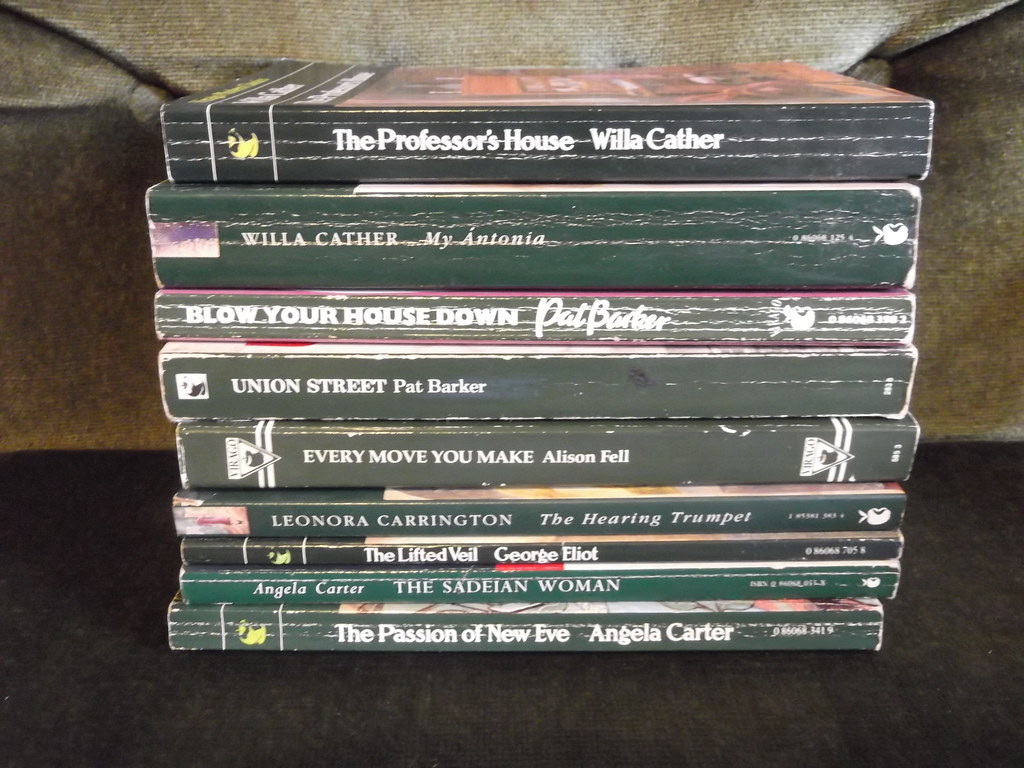
The Virago Modern Classics shelf at the London Library, which occupies one and a half bays of the third-floor stacks, holds approximately 640 titles in their original green-spine paperback editions, arranged alphabetically by author. The collection is not complete. The series has published over 700 titles since its launch in 1978, and the library does not stock the more recent inductions.
Carmen Callil, who founded Virago in 1973 and launched the Modern Classics line in 1978, died in October 2022 at the age of eighty-four. She had stepped back from the editorial direction of the Modern Classics in the late 1990s, but the imprint she built has continued, through three changes of corporate ownership and at least four redesigns, to keep the green spine on bookshop shelves.
The 2026 spring list includes six Modern Classics titles. The lead is a new edition of the Caribbean novelist Sylvia Wynter's The Hills of Hebron, originally published in 1962 and last available in the Virago series in a 1984 edition that went out of print in 1991. The Wynter is the imprint's first major recovery of a Caribbean novelist in over a decade.
The other five titles are reissues of existing Modern Classics: Antonia White's Frost in May, which has been in the series since 1978; Rosamond Lehmann's The Echoing Grove, in the series since 1981; Storm Jameson's Company Parade, in the series since 1982; Molly Keane's Good Behaviour, in the series since 1981; and the American novelist Dawn Powell's The Locusts Have No King, added to the series in 2001.
These are all books that have been in continuous Virago print for between twenty-five and forty-eight years. Their longevity is the imprint's quietest achievement. A book that has been in print for forty-eight years is no longer a recovery. It is a fixture.
Adler, who has been reading the Modern Classics since she bought her first Antonia White at a Boston bookshop in 1989, has spent a fair amount of time over the past year trying to understand what the imprint has been doing in its fifth decade. The answer is mostly: holding the line.
Holding the line, for an imprint of this scale, is not a small task. The Virago Modern Classics list now contains over 400 titles in print, supported by a publishing programme of between eight and fourteen new editions a year. Some of these new editions are first-time Modern Classics inductions. Others are reissues with new introductions, new translations (where applicable), or new editorial apparatus.
The first-time inductions have slowed since the early 2000s. In the imprint's first decade, Virago was inducting forty to sixty new titles a year. In the second decade, twenty to thirty. In the third decade, ten to fifteen. In the fourth and fifth decades, the pace has settled at five to ten per year.
The slowdown reflects a real and unavoidable change. The first decade had the entire prior history of women's English-language fiction to draw from. The fifth decade is working with a much smaller pool of major recoveries waiting to be made. Most of the obvious twentieth-century women novelists are already in print, often in multiple editions.
What remains, for an imprint like Virago in 2026, is the harder work of recovering the genuinely marginal writer, the writer whose recovery requires significant editorial investment to set up, the writer whose audience will need to be built rather than inherited.
The Sylvia Wynter reissue is exactly this kind of recovery. Wynter, born in Cuba in 1928 and raised in Jamaica, is best known to current readers as a theorist of race and modernity, the author of a series of essays in the 1990s and 2000s that have become foundational in postcolonial studies. Her fiction, of which The Hills of Hebron is the only completed novel, has been much less read than her theoretical work.
The Virago edition includes a new introduction by the novelist Marlon James, who has been an advocate for Wynter's fiction for over a decade. James's introduction, which runs to about 5,400 words, makes the case for the novel as a foundational text of post-independence Jamaican fiction. Whether the case will land with current readers is, as always, an open question.
The first printing is 4,200 copies, which is modest by Virago standards but realistic for a Caribbean novelist whose fiction has been out of print for thirty-five years. Adler expects the title to sell through that printing within eighteen to twenty-four months, with the academic adoption market accounting for perhaps a third of the sales.
The Antonia White reissue, by contrast, is straightforward steady-state publishing. Frost in May has been in continuous Virago print since November 1978, when it was the first title published in the Modern Classics series. The book sells, on average, between 3,800 and 5,200 copies a year, with school and university adoption providing a stable floor.
The new 2026 edition replaces a 2010 reprint that had begun to show signs of wear in its paper stock and binding. The redesign is minor: the green spine is unchanged, the cover image (a detail from a 1934 Eric Ravilious wood engraving) is unchanged, the typography has been slightly refreshed.
These two reissues, taken together, illustrate the work the imprint is now doing. On the one hand, the careful steady-state maintenance of the core list. On the other, the occasional but significant recovery that requires substantial editorial investment to set up. The proportion has shifted, over the imprint's lifetime, toward the maintenance work. But the recovery work has not stopped.
The Wynter is not the only major recovery on the imprint's near-term horizon. The 2027 list, which was discussed in conversation with the Virago editor Lennie Goodings (who has been with the imprint since 1978 and who took over the editorial direction from Callil in 1995), is expected to include first or first-in-decades Modern Classics editions for at least three writers, including two Black British novelists from the 1960s and a Pakistani novelist last published in English in the 1970s.
These are the kinds of recoveries that the imprint's first decade did not get to. The 1978 list was English, mostly white, mostly middle-class, mostly interwar. The 2026 list is wider in every dimension. The widening has been slow and not always successful, but it has been continuous since at least the early 2000s.
Whether the widening will continue at its current pace through the next decade depends on factors the imprint does not entirely control. Library budgets are not what they were. Academic adoption of mid-century women's fiction has plateaued. Independent bookshops are fewer and smaller than they were when the imprint launched.
On the other hand, the green spine is one of the most recognisable design properties in contemporary trade publishing. The Virago Modern Classics shelf, in any reasonably literary bookshop in the English-speaking world, is identifiable from across the room. This kind of visual continuity, sustained for forty-eight years, is itself a publishing asset.
Adler left the London Library on a Friday afternoon in late May with a copy of the Wynter and a fresh appreciation for the slow institutional work that keeps a series like Virago Modern Classics visible to a new generation of readers. The green spine is the same green it has been since 1978. The list, on the inside, is doing more work than the spine lets on. Forty-eight years of work, and counting.