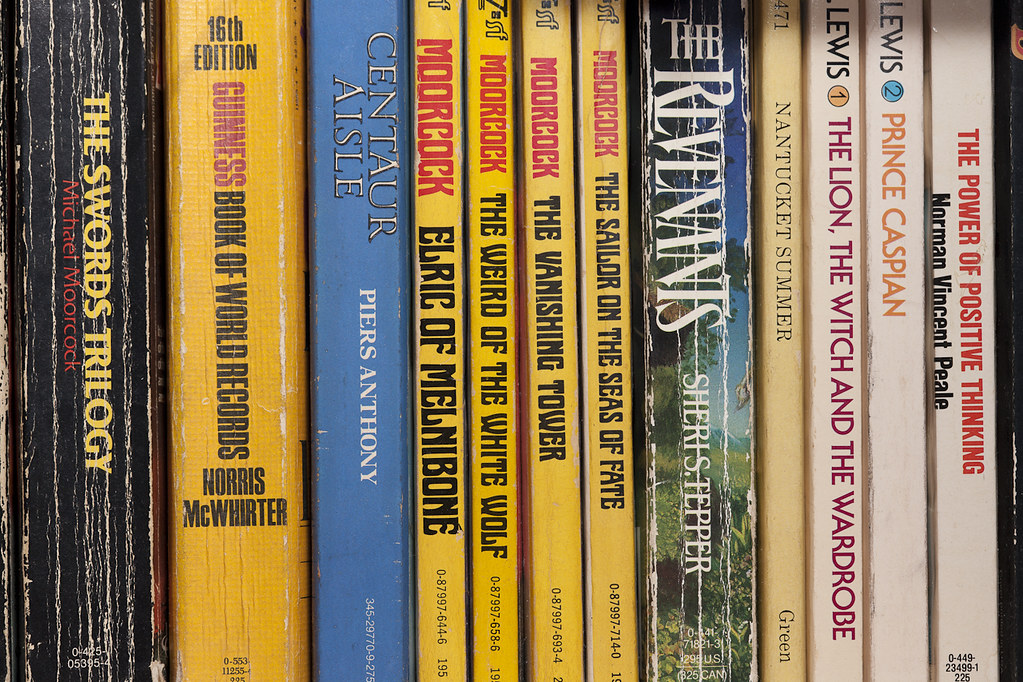
At the Regina Public Library, on a shelf in the literary fiction section, twenty-three NYRB Classics titles sit together because a librarian named Halima Yusuf arranged them that way in 2019. Yusuf, who has since retired, told her successor that the books should be kept together because their readers tended to want them together.
This is the small but visible result of a design decision made in New York in 1999. Edwin Frank, the founding editor of the New York Review of Books's reissue imprint, decided that every book in the line should carry the same black-bordered cover format, the same matte finish, the same typography, and the same general visual posture.
The decision has held for twenty-six years. The imprint has now published over four hundred and twenty titles. Almost every one of them is recognisable, across a bookshop floor or a library shelf, at a distance of fifteen feet.
This is the engine of the project. The uniform jacket has done what no marketing campaign could have done: it has trained readers to trust the imprint before they have heard of the author.
The books themselves are eclectic. They include nineteenth-century French novels, twentieth-century Hungarian memoirs, mid-century American crime fiction, classical Chinese poetry in translation, Russian short fiction from the Soviet thaw period, and the occasional Latin American novel that fell out of English-language print between its first publication and its NYRB recovery.
The list does not pretend to coherence beyond the editorial judgement of Frank and his small editorial team. The books are chosen, by Frank's own account, because they meet a single test: he believes they should be available to English-language readers, and they are not currently available, and they are interesting enough to be worth the cost of recovery.
That test is more demanding than it sounds. The imprint receives, in any given year, hundreds of suggestions from translators, critics, scholars, and readers. It publishes between fourteen and eighteen titles annually. The rejection rate, by Frank's account, runs above ninety-five per cent.
What is rejected is not, in most cases, bad. What is rejected is, more often, work that does not meet the imprint's specific use case. NYRB Classics is not interested in publishing books that other imprints would happily publish. It is interested in publishing books that no one else has chosen to bring back.
This is a particular editorial niche, and it is a niche that has, against the expectations of the publishing trade in 2000, sustained itself for a quarter of a century. The imprint is, by all accounts, profitable. The parent company has expanded the line steadily across its history.
The economics, Frank has explained in several published interviews, depend on the long sales tail. An NYRB Classics title is not expected to make its money in the year of its publication. It is expected to make its money over the first ten years of its life, with strong contributions from the second five.
This is possible because the imprint keeps every title in print. There is no remaindering programme in the conventional sense. Books that sell slowly continue to be available; books that sell unexpectedly well are reprinted as needed.
The print runs are correspondingly modest. A typical first run for an NYRB Classics title is between four and six thousand copies. A title that finds wider readership, such as Stefan Zweig's Chess Story or Yuri Olesha's Envy, may go through three or four reprints in the first decade.
Some titles, however, never need a reprint. A 2008 reissue of a forgotten 1957 novel by an Italian writer whose name was unfamiliar even to specialists may sell six hundred copies in its first three years and then settle into a stable backlist rhythm of forty or fifty copies a year for the next twenty.
This is the imprint's secret: it can afford to publish such a book because the uniform jacket and the imprint's accumulated reputation guarantee that the book will not disappear into invisibility. It will sit on the shelf next to its better-selling siblings and be available to the one reader, every year or two, who is looking for exactly that book.
The translation programme within NYRB Classics has expanded significantly over the imprint's life. In its first five years, translations accounted for roughly forty per cent of titles. They now account for nearly seventy per cent.
This shift reflects, in part, the increasing scarcity of out-of-print English-language books worth recovering. The English-language literary canon has been more thoroughly preserved than the imprint's founders perhaps expected in 1999. The recovery work has, accordingly, moved increasingly toward translation.
The translators NYRB Classics works with form a small, recurring pool. The imprint has commissioned new translations from established translators including Edith Grossman, Lydia Davis, Michael Hofmann, and Margaret Jull Costa, among many others. It has also brought back into print older translations whose quality has, in its editors' judgement, not been surpassed.
The question of when to commission a new translation and when to reissue an older one is, Frank has said, the most contested editorial decision the imprint regularly makes. The answer is usually a matter of the specific text and the specific translator, not a matter of policy.
The third-decade question for NYRB Classics is whether the model can be sustained without Frank himself. He is now in his late sixties, and the imprint has begun to acknowledge, publicly and privately, that succession planning is in progress.
What will not change, Frank has said, is the jacket format. The black border is, at this point, more important than any single editorial decision. It is the contract with the reader. A reader who picks up an NYRB Classics title at a bookshop in Saskatoon or Cape Town or Glasgow knows what they are getting before they read the first sentence.
That trust took twenty-six years to build. It will, presumably, take less time than that to lose if the imprint mishandles the next decade. The black border is, in this sense, the most consequential design decision in twenty-first-century American book publishing.
That is not a small claim. It happens to be, as far as the evidence goes, true.